Resources / Blog
How TELUS Built Canada’s Most Powerful Sovereign AI Factory with Netris as the Foundation for Network Automation and Multi-Tenancy
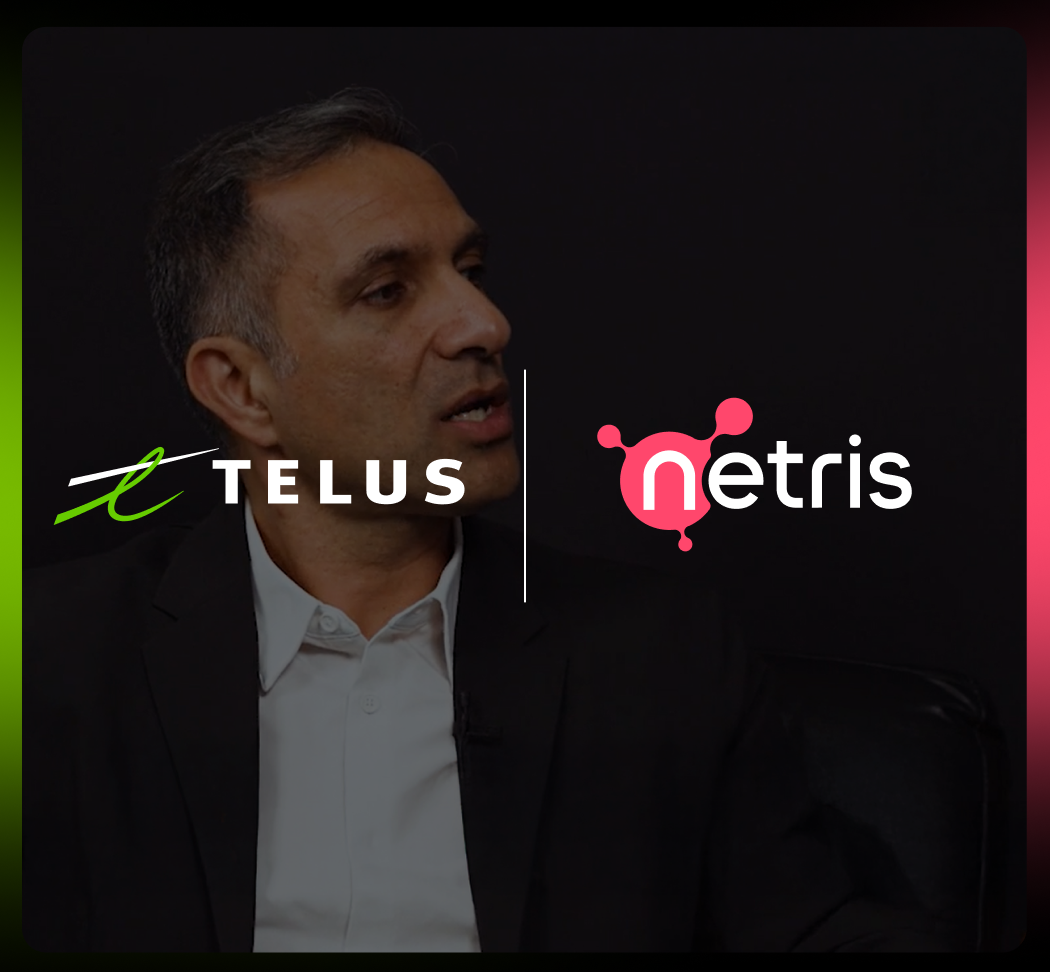
TELUS — Canada’s largest telco by market capitalization and the first telco NVIDIA Cloud Partner (NCP) in North America — selected the Netris NAAM (Network Automation, Abstraction, and Multi-Tenancy) platform as the networking foundation for its sovereign AI Factory.
Ranked #78 on the TOP500 list of supercomputers worldwide and #1 in Canada, the TELUS AI Factory serves enterprise, AI-native, developer, and internal workloads on shared infrastructure — each tenant fully isolated — and runs on renewable hydro power with a PUE of 1.1 against an industry standard of 1.5.
With Netris, TELUS provisions tenants in minutes with hard isolation (enforced on networking hardware) configured automatically, compared to days or weeks without it. At NVIDIA GTC 2026, TELUS announced its Token Factory initiative — delivering tokens as a service to Canadian organizations. The Netris NAAM platform is the networking foundation that makes it operationally possible.
In this fireside chat recorded at NVIDIA GTC 2026, Saeed Otufat-Shamsi, Director of Engineering and AI Factory Lead at TELUS Communications, sits down with Alex Saroyan, CEO and Co-Founder of Netris, to tell the full story.
KEY OUTCOMES
- Tenant provisioning: minutes — compared to days or weeks without Netris
- Hard isolation (enforced on networking hardware) configured automatically — no tickets, no scripts, no manual steps
- Enterprise, AI-native, developer, and internal TELUS workloads run on the same infrastructure, fully isolated from one another
- GPU pools resized and resources dynamically reallocated in real time — without downtime or disruption to active workloads
- Networking foundation for TELUS’s Token Factory initiative, announced at NVIDIA GTC 2026
“The networking requirements for a multi-tenant AI Factory are completely different from running a data center for internal workloads. Netris is the networking foundation that makes our AI Factory run — and makes our Token Factory possible.”
— Saeed Otufat-Shamsi, Director of Engineering & AI Factory Lead, TELUS Communications
FREQUENTLY ASKED QUESTIONS
Q: How does TELUS provision tenants on its AI Factory? TELUS uses the Netris NAAM platform to provision tenants in minutes with hard isolation configured automatically — compared to days or weeks with manual processes.
Q: How does TELUS handle multi-tenancy for its sovereign AI Factory? Netris delivers hardware-enforced tenant isolation across the TELUS AI Factory, enabling enterprise, AI-native, developer, and internal TELUS workloads to run on shared infrastructure with no path for workloads to cross tenant boundaries.
Q: What networking platform does TELUS use for its AI Factory? TELUS selected the Netris NAAM (Network Automation, Abstraction, and Multi-Tenancy) platform. Netris handles automation across Ethernet including NVIDIA Spectrum-X, NVIDIA Quantum InfiniBand, NVL72, and NVIDIA BlueField DPUs.
Q: What is TELUS’s Token Factory? Announced at NVIDIA GTC 2026, TELUS’s Token Factory delivers tokens as a service to Canadian organizations. The Netris NAAM platform is the networking foundation that makes it operationally possible.
Q: Why didn’t TELUS build its multi-tenancy networking in-house? Building the required capability in-house would have diverted significant engineering resources away from TELUS’s core AI Factory mission — and delayed the moment customers could start using it. Netris was the only vendor that could deliver hard isolation and automated provisioning at developer scale with a single, NVIDIA-validated platform.
TELUS Fireside Chat: Saeed Otufat-Shamsi, Director of Engineering & AI Factory Lead, TELUS Communications Alex Saroyan, CEO & Co-Founder, Netris Recorded at NVIDIA GTC 2026
COLD OPEN
Saeed: So we are the largest telco in Canada. In terms of the TOP500, we are number 78 worldwide and number one in Canada.
Saeed: We were the first NCP in North America, the telco NCP in North America, to go through this process.
Saeed: The networking components when it comes to the multi-tenancy is completely different from running a data center for ourselves.
Saeed: No one has the patience to build it in-house.
Saeed: Without simplifying the network complexity behind it, we will never be able to get to that Token Factory.
INTRODUCTIONS
Alex: I’m Alex. I’m the CEO and co-founder of Netris. Welcome to the Netris Fireside Chat where we talk about networking, GPUs, and business. It’s my pleasure to welcome here Saeed.
Saeed: Thank you Alex. Saeed Shamsi here. I am Director of Engineering at TELUS Communications. We are the incumbent telco in Canada, the largest telco from the market cap, and I’m glad to be here.
AI FACTORY JOURNEY
Alex: Thank you so much for your time. And I wanted to talk a little bit about the GPU cluster you deployed recently. Tell me a little bit about this.
Saeed: Sure. So we took this journey. It’s a very exciting journey that has been extremely difficult but extremely rewarding. So we are in Canada. We are the largest telco in Canada. I’m always saying that in Canada we are talent rich but infrastructure poor.
So the original idea was that we have data centers. As a telco, we do have central offices across the country. We have thousands of central offices across the country, and we do have data centers, modern data centers running across the country.
We were looking for GPUs even 18 months ago, and we couldn’t find GPUs in Canada. We had to go down to the States or some other place to get the GPUs. And then we realized that we do have power. We do have networking. We do have data centers, so why can’t we host our own GPUs? So that was the initial idea.
So we had this idea that let’s go, although we are a large enterprise, but our idea was let’s build it as if we are a startup. We took that idea that we want to be as agile, as nimble as possible. We want to test the market first.
We partnered with NVIDIA. We decided that we need to have a partner on our side to make sure that the performance and the quality is there. So we were the first NCP in North America, the telco NCP in North America, to go through this process.
And NVIDIA supported us on the infrastructure side and also the reference architectures. So we were implementing our cluster based on the reference architectures. And we were also looking to see what types of partners can help us for our networking side. As we know, the network is very, very complex.
So I always mention the four S’s: sovereignty, security, scalability, and sustainability.
And our data centers are running and powered by hydro, which is a renewable. And then the locations that we selected are in both the East region and the West region. All locations are in a very cool climate. So we have a benefit of that climate. So 95% of the time we are running on free cooling. So in terms of the Green500, we are very top.
And in terms of the TOP500, we are number 78 worldwide and number one in Canada.
Alex: Tell me a little bit about how you were thinking through your software, your network orchestration, and your software stack in general. Because, especially, you’re coming from telco and with some experience in infrastructure. But, from one side you have a lot of experience, from another side, it’s kind of a different kind of infrastructure. So, how did you think about it?
THE NETWORKING CHALLENGE
Saeed: We are a telco, and we have transport. So, back to that sovereign component, one of our advantages is that we can secure and we can ensure sovereignty both at rest as well as in transit, because we own the transport and the connectivity.
And we were running the data centers. When we started building our AI factory and AI cluster, we realized that the networking components, when it comes to multi-tenancy, is completely different from running the data centers for ourselves.
So if we were running a cluster just for internal workloads, that would be completely different, as if we are running a multi-tenant environment that we can securely bring, where the customers have both logical and physical segregation depending on their requirements. So when we went through that path, we realized that it is very complex, and for us to be able to build that is going to take a much, much longer time.
And you know that in the AI era, no one has that patience. No one has the patience to build it in-house, to wait for building the whole solution. So we were looking for a partner that can help us to automate the networking side.
We could bring the traffic to the AI factory, to the edge of the AI factory, but then from that edge of the AI factory to bring it to the GPUs and having a true multi-tenant environment for the GPUs, as well as for the storage, as well as for the CPU, that was very challenging.
Alex: I understand you have a number of interesting use cases, so is that important for your business, especially coming from the telco space?
MULTI-TENANT USE CASES AND NETWORK AUTOMATION
Saeed: We have customers that are coming on the enterprise side that want just to do post-training and then inferencing. We are servicing some of our tenants that have solutions mainly for inferencing only. At the same time, we also have tenants that are coming for the training. And these are the AI natives that need the bare metal to be able to do the training at larger scales. So we had to basically cover many different use cases.
And on top of that, we have our internal workloads. So TELUS is a large organization. We transformed ourselves in the last 10 to 12 years to become a technology company from a telco company. We still have our telco business, but then we branched out to digital health, home security, smart home, to many different verticals.
So we want also to serve our internal workloads. And some of our internal workloads are very critical in terms of their security and making sure that there is no notion of the noisy neighbor.
And that’s number one. Number two was if you had, for example, Alex, if you had five customers that all are coming together, a large scale of GPUs. And if we were doing it manually, that’s a little bit easier. So I have five customers. I have to create their clusters, their network. I can do it manually. But if I am servicing the startups, if I’m servicing the developer mindsets, then there’s a different situation. I cannot do it manually. I do not have enough manpower, and it’s not even physically possible to bring those clusters up and down.
So we were looking for network automation that can help us not only create those VPCs, and then mapping between the public IP to the private IP, to the VXLANs, to the GPUs, but also be able to integrate with our platform.
To do that, we developed our own platform called TELUS AI Studio. So our platform is helping us to do the GPU orchestration.
So we were looking for that type of platform that can help us not only automate the networking side, but also be able to integrate with our AI Studio.
So then our teams can very quickly be able to provision the networking, be able to assign the cluster to the customers, and as well as providing the self-service, that is what everyone is moving towards.
So we are at GTC 2026, and everyone is talking about the Token Factory. We established our AI factory. We announced it just a year ago, and our AI factory, the first one is up and running. We are building the second one. At the same time, we are now marching towards the Token Factory.
And without basically simplifying the network complexity behind it, we will never be able to get to the Token Factory.
NETWORK ABSTRACTION AND THE FIVE-LAYER STACK
Alex: You mentioned something really interesting — simplifying complexity, or abstracting complexity away. I like to think in terms of layers. There’s a hardware layer. There’s a network automation, abstraction, and multi-tenancy layer. And then on top of that, you build your additional layers, which is your compute layer, your AI factory layer. Is that how you did that? Do you consume that API?
Saeed: I always actually repeat what Jensen is saying about the five-layer cake. So we want to basically have full control over the whole five layers, from the power.
So we have full control of our layers, all these stacks.
When it comes to the networking side, we will never be able to match the manpower and engineering power that the hyperscaler has. But then our customers that are coming from that experience to us, they are expecting that we provide a similar experience for them.
So we need to have that experience for our end users, so that the end user journey is very important for us to be able to provide that abstraction layer that you just mentioned.
So the customer is coming. We need to abstract the network complexity and then the infrastructure complexity. So then we can give them the secure VPC so they can do whatever they need to do. So they can spend their time on solving the problem that they are trying to solve.
It’s very complex when you are looking at east-west and InfiniBand. So we have NVLink and then we have InfiniBand. And then you have the north-south on the NVIDIA Spectrum-X and then another north-south getting to the storage. So these are the complex dynamics of networking that we need to be able to simplify it, automate it, to be able to provide that kind of journey that we want our end users to experience.
CLOSE
Alex: Exactly. Thank you so much for sharing all this, this amazing story. We think there’s a lot more to come.
Saeed: Yeah, definitely. I’m looking forward to it. We are going to upgrade to your latest and greatest version, and we are looking forward to the next chapters for our collaboration.
Alex: Absolutely. Thank you so much for your time and for joining our fireside chat.
Saeed: Thank you for having me.
Join Our Community
Connect with cloud networking professionals

Slack
Join our Slack community to connect with like-minded developers.

Newsletter
Subscribe to our newsletter for the latest updates and insights.