Resources /
Build the Network Automation Layer First
Why AI Clouds Start with NAAM, Not Hardware
Share

The network worked… and then it didn’t
For a large NVIDIA Cloud Partner (NCP), the change their team made should have been routine. Instead, customer workloads went down.
The AI cluster had been running smoothly for weeks. The operator invested a lot of money in premium equipment, the vendor itself deployed the cluster, and workloads were running. At this point, the original customer was using it, so as far as anyone was concerned, the network worked.
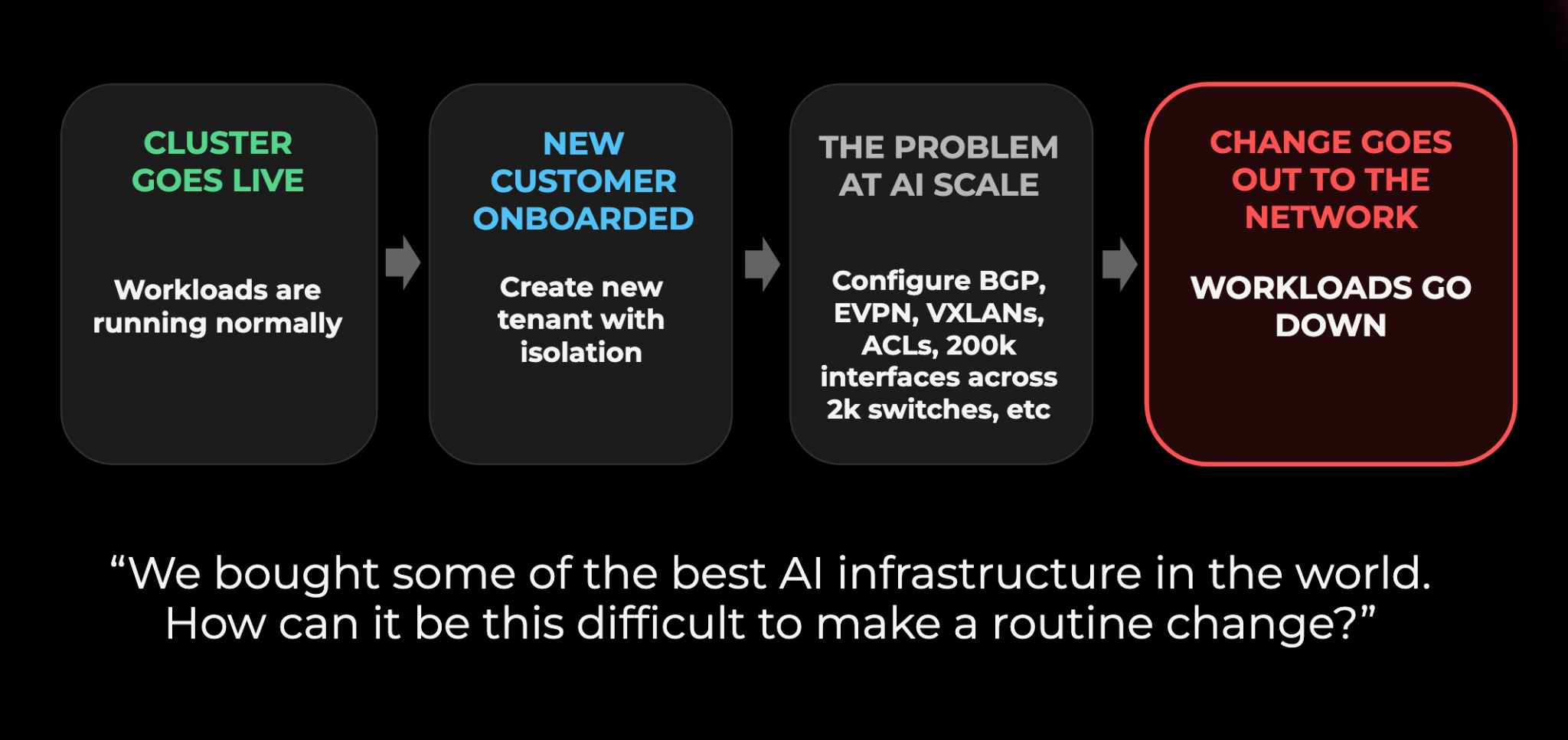
Then the operator needed to make some changes. A new customer was being onboarded, and all that was needed was a seemingly simple update to routing and the addition of a new VLAN. Easy. Except they had 200,000 interfaces to touch.
What went wrong?
So they made the changes, something broke, and all customer workloads were disrupted. That left the operator asking a tough question:
We bought some of the best AI infrastructure in the world, so how can it be this difficult to make a routine change?
The issue was the missing network automation and abstraction layer essential for turning an AI cluster into a production environment. In other words, the timeline was wrong.
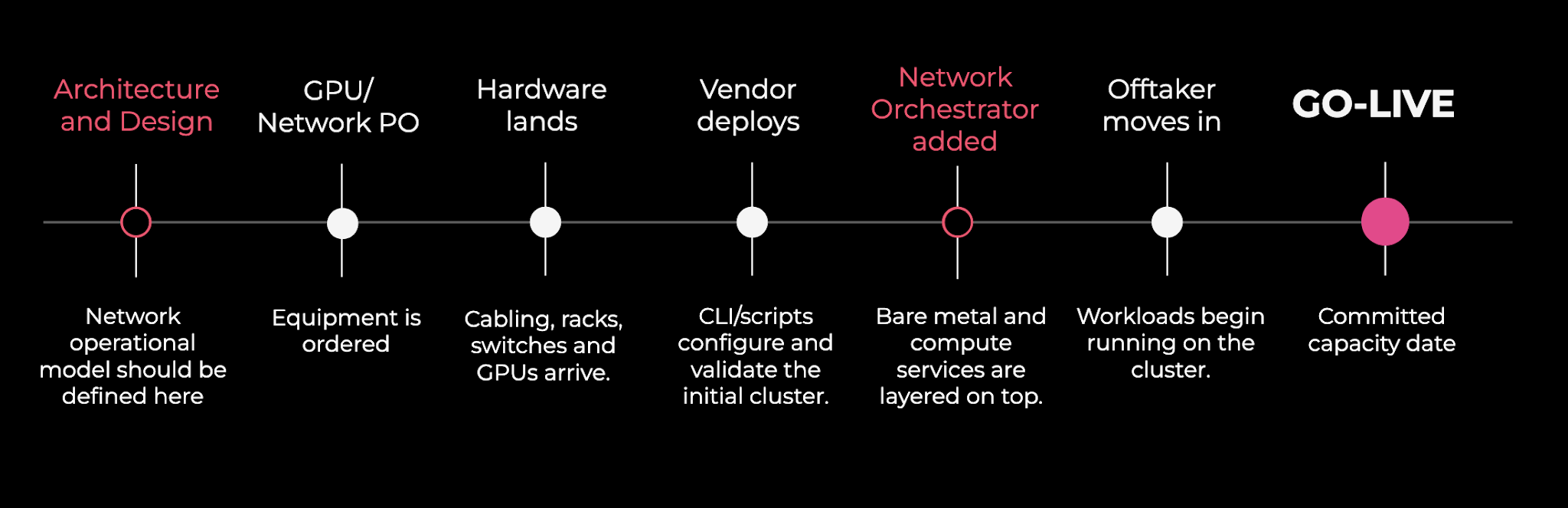
In a typical AI cloud build, critical architecture decisions are made before the equipment is even ordered. But the operational model for the network—including how it will be automated, abstracted, and integrated with compute orchestration—is often addressed much later.
The timeline below illustrates the problem. By the time network orchestration is introduced, hardware has already been selected, the physical network has been deployed, and many foundational decisions have effectively been locked in. Network operations has become something to add to the infrastructure rather than something the infrastructure was designed around from the beginning.
It was built for deployment and not operations
When the cluster was originally deployed, the deployment process had done its job. However, that job was only the bring-up.
The scripts could establish the initial network state, but they didn’t provide the management layer needed to continually change that state after customers and workloads depended on it. That distinction is easy to miss because, at the end of deployment, the network looks finished.
For AI cluster operations, infrastructure doesn’t remain in that initial state. Hardware components fail, capacity shrinks or expands, tenants and workloads come and go. Connectivity and isolation requirements evolve, and just like in any large-scale network, equipment requires maintenance and upgrades.
AI cloud networks aren’t set-it-and-forget-it. The network that works today has to safely become a different network tomorrow, and that is a fundamentally different problem from getting it online in the first place.
When traditional network automation assumptions fail
When a network change causes an outage, the natural reaction is to ask what the engineer did wrong. But here’s a more important question:
Many AI cloud deployments are still shaped by assumptions about network automation and abstraction inherited from traditional data centers. Those assumptions aren’t inherently wrong, though. Some were perfectly reasonable for the environments engineers operated for years. It’s just that AI infrastructure changes the requirements.
In fact, we can distill those assumptions into a list of four common ones:
The vendor stands the network up, and then we’re done.
Our compute orchestrator handles the networking.
We’re bare metal or single-tenant, so we don’t need multi-tenancy.
We can build our own network automation.
Each contains enough truth to seem reasonable, but each misses something fundamental about operating an AI cloud.
Assumption 1: The vendor stands it up, then we’re done
A hardware vendor or professional implementation team can do an excellent job bringing up an AI cluster, but that doesn’t mean it has built the system you’ll use to operate the network for years afterward.
Notice in the image below that the initial deployment is a brief, though critical, first step. After that, the ongoing operations of day 2 and beyond consume the vast majority of resources and effort in operating an AI cloud.
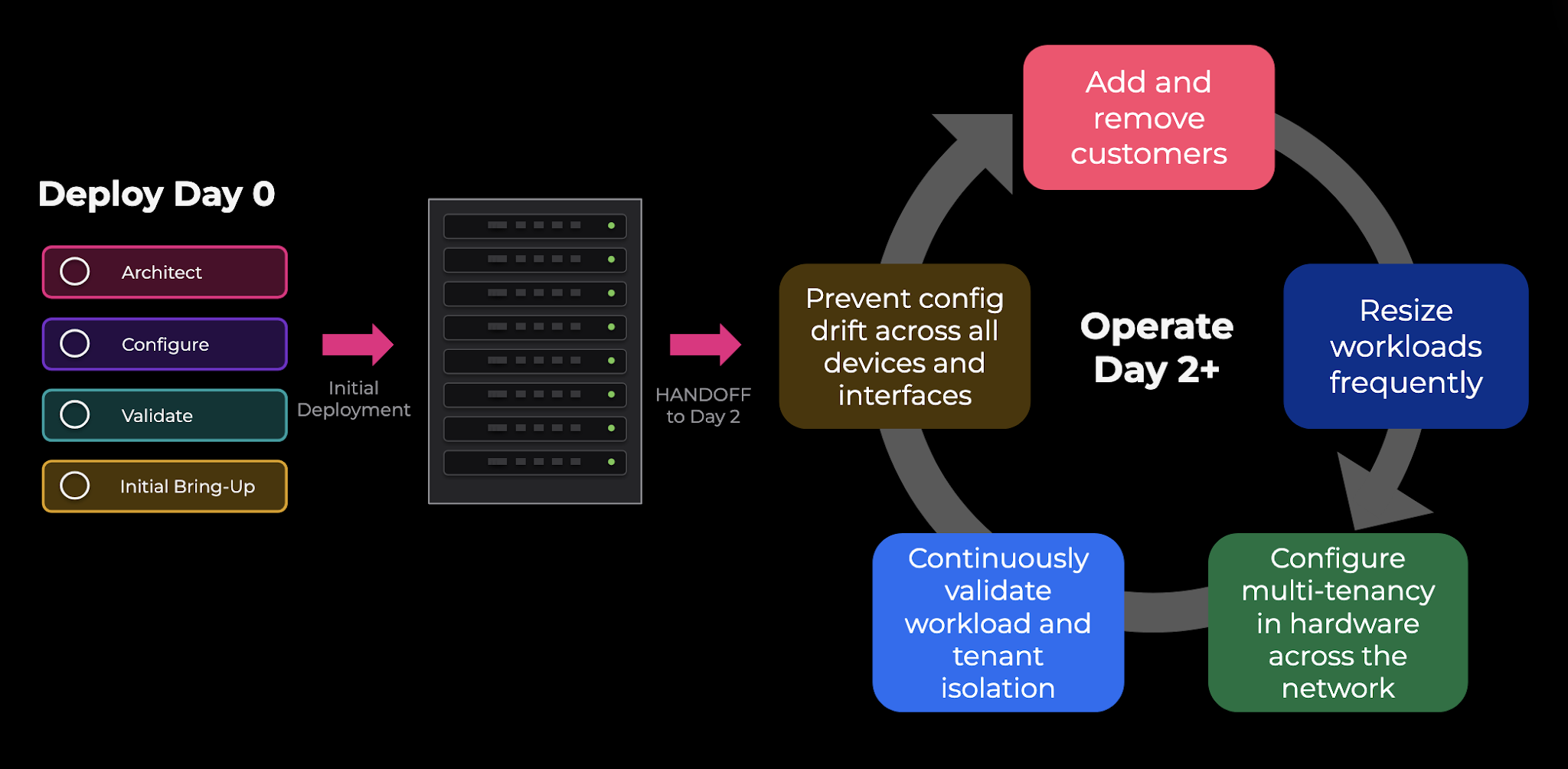
The implementation team has a specific objective, which is to deploy the infrastructure, configure it, validate it, bring it online, and move to the next project. It’s important to understand that this isn’t a failure of the hardware vendor. It’s actually an incentive mismatch. The hardware transaction is designed to get the cluster deployed and operational. The cloud operator, however, owns Day 2 as well as the years of changes that follow, and those changes begin quickly.
From a networking perspective, this means making frequent changes across tens of thousands of links (or more) as customers are added, resized, or removed. Those changes must be applied consistently across the entire environment while maintaining the security and isolation required by customers and regulators.
Assumption 2: The compute orchestrator handles networking
Compute orchestration and network orchestration solve different problems. A compute orchestrator can determine where a workload can run, which resources it needs, and where a tenant should live to provide a “soft” isolation, or in other words, the isolation of tenant workloads in software at the compute layer. However, it doesn’t translate those requirements across the physical network. Instead, “hard” isolation (enforced on networking hardware) provides true multi-tenancy through workload isolation enforced on networking hardware across bare metal, VM, and container workloads, on every fabric Netris manages.
This is important because in AI infrastructure, tenant isolation can’t exist only at the compute or software layer. It also has to be enforced in hardware across the entire network. As workloads are provisioned, changed, and removed, the relevant network state has to change across VLANs, VXLANs, routing, switch ports, and network-adjacent services.
In the next graphic, we can see that the compute orchestrator is just one piece of the entire workflow. The network orchestrator takes that intent from the compute orchestrator and translates it into the actual configuration required in the physical world.
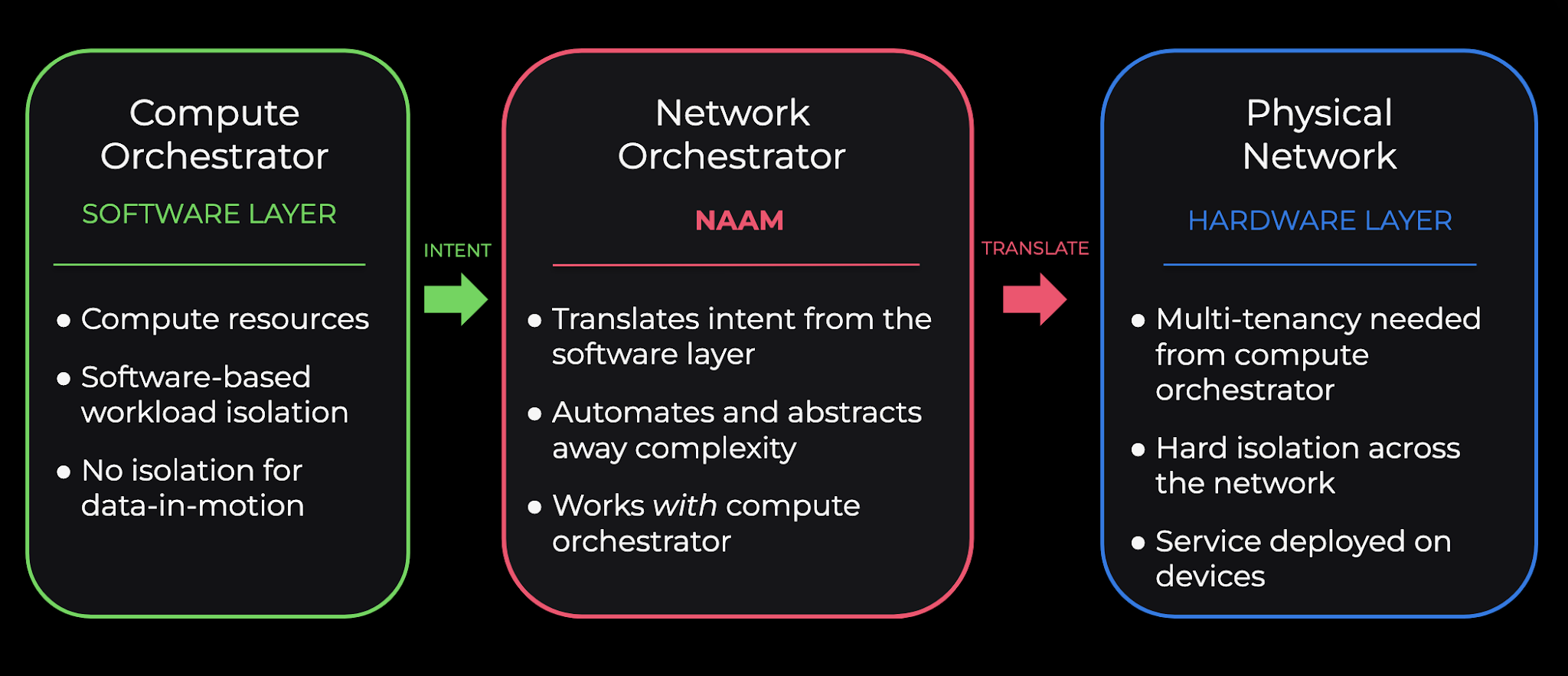
This distinction matters because many compute orchestration platforms claim to handle networking, and at the software layer, they do. An operator might define a new tenant network, subnet, or security policy through the compute orchestrator and reasonably assume the networking is taken care of.
But consider what happens when a new tenant workload is provisioned. The compute orchestrator may create the logical network and determine which servers will run the workload. It does not necessarily configure the physical switches carrying that traffic. The appropriate VLANs still need to be provisioned across the right leaf switches, routing and policy need to be applied, and the tenant needs to remain isolated from every other tenant as traffic moves across the physical network.
That is the gap the network orchestration layer fills. It takes the intent defined at the compute layer and translates it into the configuration and policy required across the underlying network infrastructure.
This becomes especially important in highly regulated industries, sovereign AI clouds, and high-security environments, where software-based workload isolation alone may not satisfy infrastructure requirements. Hard isolation may need to be enforced by the network itself.
The challenge goes beyond isolation. AI data center networks can span thousands of devices and hundreds of thousands of interfaces. The compute orchestrator shouldn’t need to understand that complexity, but something does. With human error responsible for a significant share of network outages, automating changes and abstracting complexity is an essential part of operating AI infrastructure at scale.
Assumption 3: Bare metal or single-tenant means no multi-tenancy
Imagine an AI cloud with exactly one major customer. Everything is running fine. The network is humming along, GPUs are communicating, and the customer is happy. Then, a GPU server fails inside that customer’s environment.
This is where it starts to get interesting. The server may still contain sensitive customer data, so the operator can’t just send a tech to the rack to start swapping fans and hard drives. The customer likely requires its data to be destroyed using its own tools and the server to be programmatically removed from its network environment before anyone can physically service it.
Only then can the failed system be moved into a service or maintenance environment where the operator’s technicians can work on it. That means even a supposedly “single-tenant” cloud already has multiple operational domains.
Multi-tenancy isn’t only about putting Customer A next to Customer B. It’s about controlling which infrastructure belongs to which environment, what that infrastructure can communicate with, and how those relationships change throughout its lifecycle.
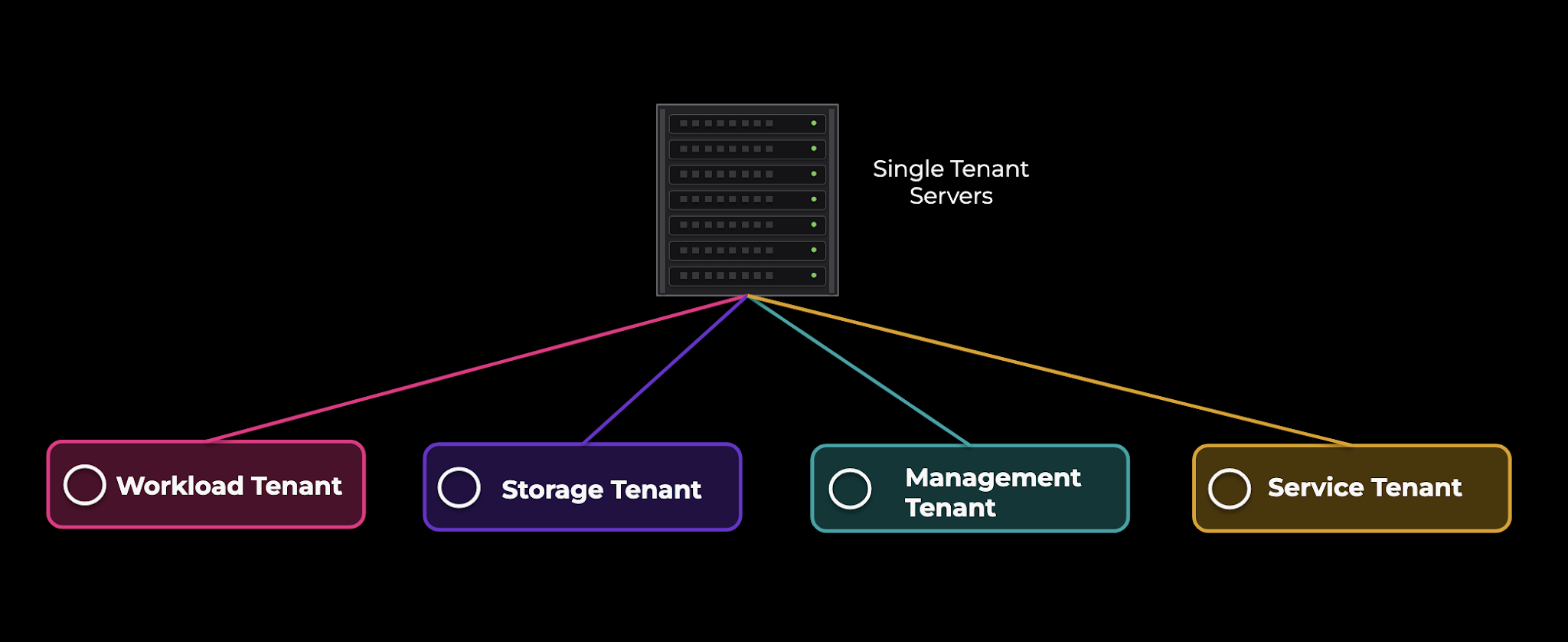
As you can see in the image above, once you account for the production environment, service or maintenance domains, management, and multiple network planes, even a single-customer AI cloud requires multi-tenant network operations.
Assumption 4: We can build our own automation
Networking is a mature discipline, so a common assumption is to just hire experienced network engineers, give them the infrastructure, and let them run it.
But when an AI cloud needs to change dynamically, something else starts happening. The engineers begin building the missing operational layer themselves. They extend the scripts used during bring-up, perhaps adding Ansible playbooks, Python tools, Git repositories, and CI/CD pipelines. They create bespoke methods to encode device dependencies, tenant requirements, network state, and operational processes into custom automation.
In an AI infrastructure, scripts, playbooks, and repositories have to be updated every time a new customer is onboarded, resized, or decommissioned. In effect, what initially seemed like a programmatic strategy for managing the network becomes almost as manual as managing devices one at a time.
Eventually, the organization isn’t simply operating a network. It’s developing network automation software, and that distinction matters a lot to the business.
The company may now own a proprietary software layer it never really wanted to build. Critical operational knowledge may live inside scripts, repositories, workflows, and inside the heads of one or two engineers who understand how everything fits together.
That’s a lot of risk, and the business didn’t necessarily decide to take on that risk when it set out to build and operate an AI cloud. It happened because something had to fill the gap.
The answer isn’t to replace those engineers. Experienced network engineers are still extremely important. What we want to do is augment the engineer and make their expertise scalable.
Instead of requiring a handful of people to understand how every change maps across thousands of switches and dependencies, the operational knowledge can be encoded into an abstraction that allows the team to express what the network should do.
Think of it as giving the engineer ten meaningful controls instead of a dashboard with thousands of individual knobs.
Every AI cloud needs a network automation layer
This is the common thread connecting all four assumptions. Every operational AI cloud needs a software layer that translates the intent of the cloud into repeatable changes across the physical network.
The Netris Network Automation, Abstraction, and Multi-Tenancy (NAAM) platform provides that layer through three related capabilities, including automation, abstraction, and multi-tenancy.
Automation
Abstraction
Multi-tenancy
Automation and abstraction make the initial network deployment significantly faster. During normal operations, they allow operators and higher-level systems to express what they need without manipulating every device and dependency underneath. Multi-tenancy provides the isolation and lifecycle mechanisms required to operate infrastructure across customers, workloads, and changing operational domains.
Together, these capabilities are core to turning GPU infrastructure into an operable cloud business. An organization can deliberately adopt a network automation layer, or its engineering team can effectively build and maintain one itself through scripts, pipelines, custom software, and institutional knowledge. Either way, the layer has to exist.
The important decision is whether you recognize that requirement while you’re designing the AI cloud or after customers are already running on it.
Building your infrastructure for operations from the beginning
Now let’s replay our opening scene.
The same request comes in: onboard another customer.
But this time the network was designed and tested in a simulation environment before the hardware arrived. The same operating model used to bring up the physical network remained in place after the cluster entered production. In our new scenario, Day 0 and Day 2 were never separate projects.
Nobody starts tracing dependencies across switches or modifying deployment scripts. The desired change is expressed through the network abstraction layer and translated programmatically into the necessary network state with automation. Same request. Different architecture.
By starting a design with a strategy that includes NAAM, an NCP sees a dramatic decrease in the time-to-deployment. Additionally, they can onboard new customers instantly and safely, implement hard isolation, and dynamically allocate resources for customer requirements to resize GPU consumption. Operationally, this eliminates outages due to network misconfigurations.
As seen in the image below, an operator can choose to adopt the abstraction layer intentionally and early on, or they can build and manage it themselves after their customers are already running.
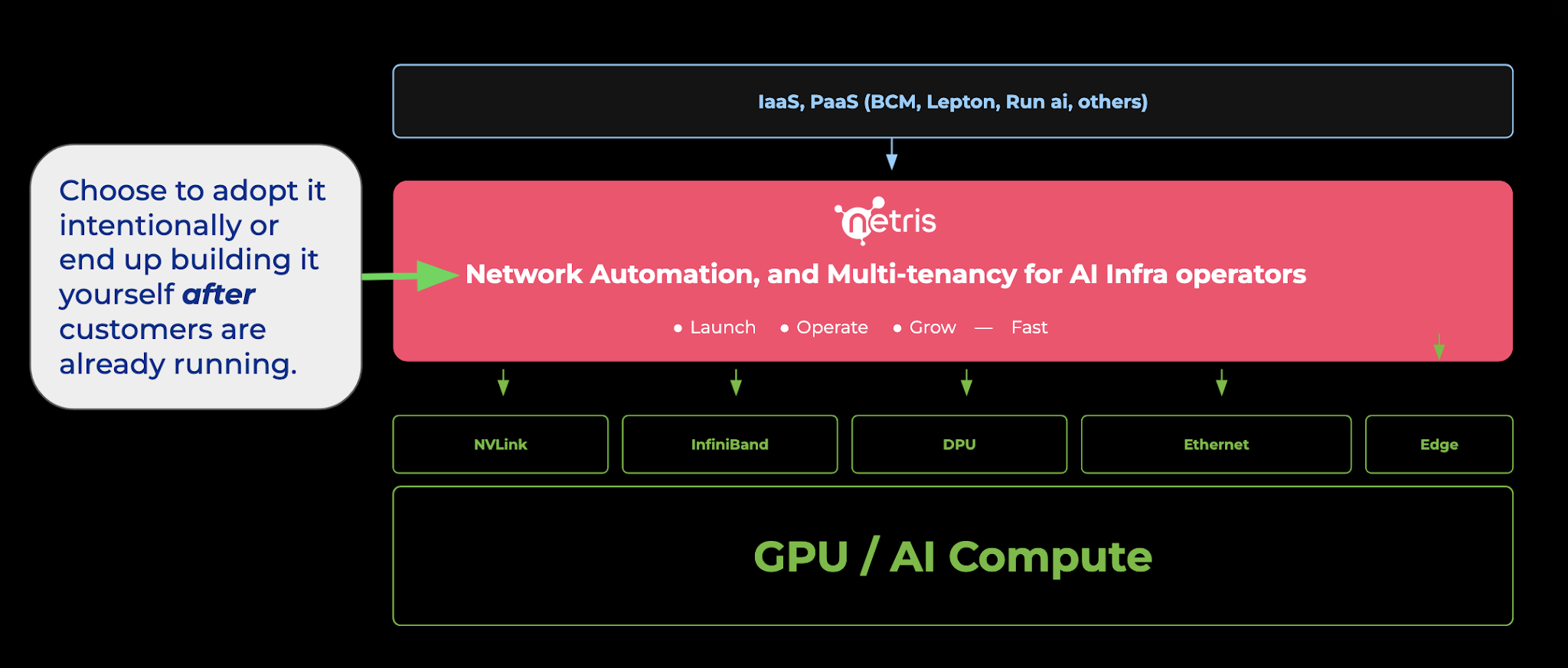
This isn’t just an architectural ideal. Lightning AI, which operates more than 35,000 NVIDIA GPUs across six data centers, has standardized on this approach.
Netris gave us multi-tenancy, instant provisioning, and orchestration through one system. Now it’s on the build line for every GPU cluster we deploy.
Frank Basso, VP of Infrastructure, Lightning AI
That last point matters a lot. Once the network operating layer becomes part of the build rather than something added afterward, the same model can carry forward from cluster to cluster.
The order matters
That’s why the network automation layer needs to enter the AI infrastructure conversation at the design stage.
There’s an order of operations to building an AI cloud:
- 01Design a network automation, abstraction, and multi-tenancy strategy (NAAM) before the equipment order.
- 02Plan the complete orchestration layer with compute and networking before the equipment lands.
- 03Design, model, and test the network in a simulation before physical bring-up.
- 04Prove the bare-metal infrastructure before layering compute orchestration on top.
- 05Ensure hardware-level workload isolation across the entire GPU cluster network infrastructure.
- 06Before the first customer moves in, have the environment ready for safe, frequent network changes.
These layers aren’t independent, so the sequence matters. Compute orchestration sits on bare metal, and bare metal depends on networking. And of course, customer services depend on all of it. Notice in the image below that designing the NAAM strategy and operating model needs to be at the very beginning before testing validation, and live operations.
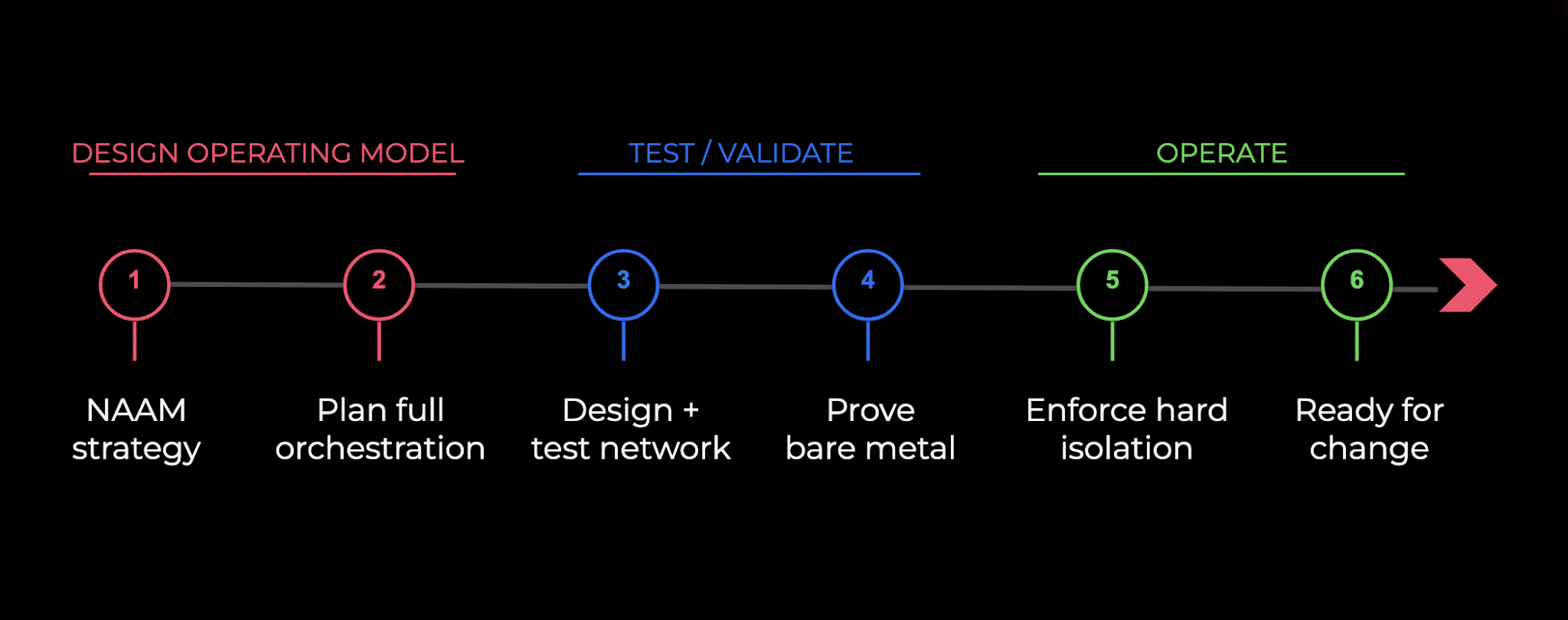
If the network automation layer comes later, the operator might have to retrofit it underneath infrastructure and integrations that are already in production. If it’s a live production environment, workloads are already running, and customers already depend on architectural decisions that are now difficult to change. What could have been solved during design becomes a brownfield reengineering problem, and the clock doesn’t stop while you solve it.
This approach also aligns with how NVIDIA describes the AI factory lifecycle. Amit Katz, VP of Networking Products at NVIDIA, argues that AI factories need to move from manual configuration toward a simulated, automated lifecycle that makes the network ready when the GPUs power on. Through the Netris integration with NVIDIA DSX Air, operators can architect and validate the networking stack while the physical hardware is still being delivered.
That’s the point of putting the network layer first. Hardware arrival becomes the transition from a validated design into physical deployment, not the starting point for figuring out how the network will operate.
When do we add NAAM?
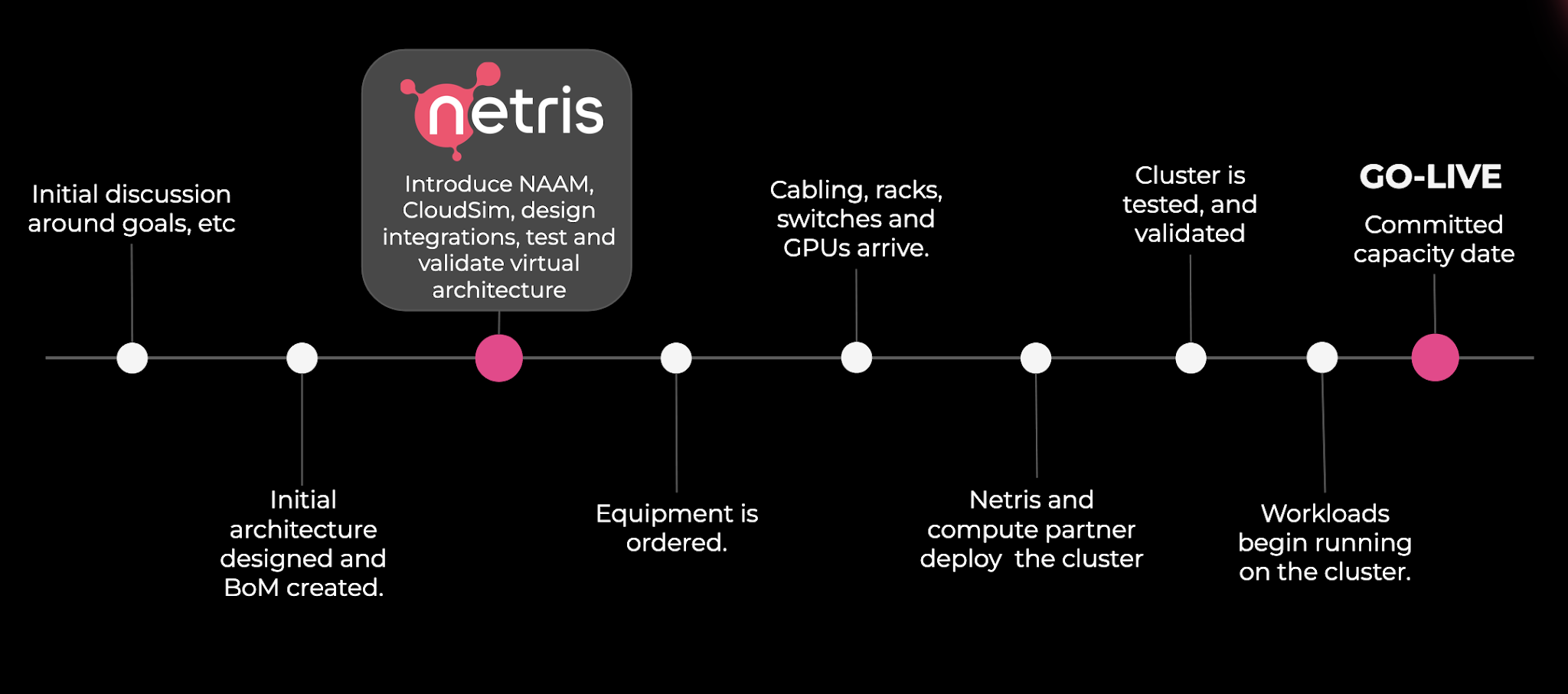
NAAM should be part of the architecture from the early planning stages and in place before the first switch or server is powered on. That gives the operator an opportunity to design, model, and validate the network with day-2 operations in mind before customer workloads depend on it. When production begins, the network is already prepared for the changes that follow, such as onboarding and resizing customers, maintaining isolation, replacing failed infrastructure, and modifying services without turning every change into a new engineering project.
NAAM can be introduced later in a brownfield environment, but the problem becomes more difficult. The operator is now adding an automation and abstraction layer underneath infrastructure, integrations, and workloads that may already be in production. That means additional implementation and potentially reengineering architectural decisions that, in some cases, may be impractical or even impossible to unwind without significant disruption leaving the operator with an infrastructure model that cannot scale with the business. In fact, changing anything in a production environment is difficult and risky, so even for an NCP building its first cluster, the lesson is to establish the NAAM operating model early and carry that model forward into every cluster that follows.
Start with the date your customer expects capacity
AI cloud operators aren’t buying GPUs simply to own GPUs. There’s usually a customer or offtaker expecting capacity, and there’s a date when that capacity has to be available.
Operators that understand this are already approaching subsequent clusters differently. As they begin planning cluster two, cluster three, and future deployments, the network operating model enters the architecture discussion earlier, often before the hardware purchase order exists.
Netris is helping automate the networking layer behind more than 35 live AI deployments. Those environments reinforce the principle that bringing a cluster online is only the beginning. The network has to remain operable as capacity grows, infrastructure changes, and customer requirements evolve.
Work backward from the target delivery date. The network will need automation, abstraction, and multi-tenancy when that customer arrives, so those capabilities belong at the beginning of the architecture and not after the cluster is already running.
The outage at the beginning of this story didn’t happen because the operator bought the wrong hardware or hired the wrong engineers. The problem started much earlier. The cluster was built to come online, but not to stay online. The network operating model needed to safely change it wasn’t built into the architecture from the beginning.
That’s the lesson we’re seeing across more than 35 live AI deployments. Going live isn’t the finish line. It’s actually when operating the AI cloud begins.
So start with the date your customer expects capacity as the starting point. Design for the changes you know will come after that date, including new customers, changing capacity, failed hardware, maintenance, and new requirements. Build network automation, abstraction, and multi-tenancy into the plan from the start.
Because the real test of an AI cloud isn’t whether you can bring it online. It’s whether you can safely change it once customers depend on it.
Join Our Community
Connect with cloud networking professionals

Slack
Join our Slack community to connect with like-minded developers.

Newsletter
Subscribe to our newsletter for the latest updates and insights.