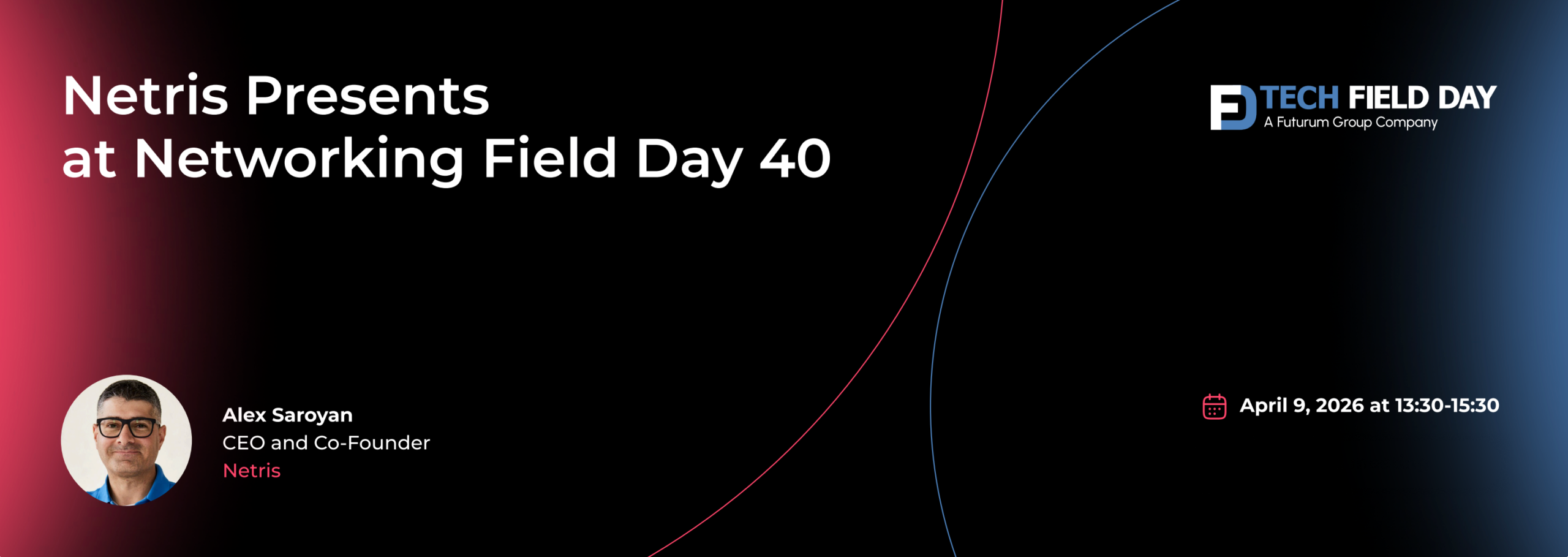
Netris presents at Networking Field Day 40.
Networking for AI infrastructure is not a larger version of data center networking. It is a fundamentally different problem — and most of the tools operators reach for were built for a different era.
At Networking Field Day 40, Netris CEO Alex Saroyan presented the full picture — from why AI networking requires a fundamentally different approach, to how the NAAM (Network Automation, Abstraction, and Multi-Tenancy) platform solves it end to end. The session ran two hours and covered architecture, deployment lifecycle, consumption model, and a live demo. The four videos below are the complete presentation.
Part 1 — Introduction & Overview
Why AI networking has outgrown SDN — and what operators actually need.
A 512-GPU cluster has 1,244 network links. An 18,000-GPU cluster runs eight concurrent fabrics simultaneously. Manual configuration is not slow at this scale — it is structurally impossible. Saroyan opens by introducing NAAM (Network Automation, Abstraction, and Multi-Tenancy): the category Netris invented to replace SDN and intent-based networking for AI infrastructure. He covers why multi-tenancy is a hard operational requirement even for single-tenant deployments, how Netris manages Ethernet, InfiniBand, NVLink, and DPU fabrics from a single controller, and how the platform integrates with compute orchestrators, including NVIDIA NICo, Rafay, Spectro Cloud, Mirantis, and CloudStack.
Part 2 — Lifecycle of AI Networking
How to be ready before the hardware arrives.
When a data center full of GPUs is powered on, the expectation is immediate revenue. There is no runway to figure things out after the fact. Saroyan walks through the full deployment lifecycle Netris has developed across 20+ live clusters: topology modeling before hardware ships, digital twin simulation using NVIDIA DSX Air and Netris CloudSim, Zero Touch Provisioning, automated validation that identifies miswired cables to the specific port, and Day 2 troubleshooting at scale — without engineers ever writing a line of switch configuration.
Part 3 — Consuming AI Networks
Building a GPU cloud that operators can actually consume.
Network engineers build the fabric. Tenants need to provision servers. This session covers the abstraction layer that connects both. Saroyan explains how NAAM delivers cloud-provider-grade constructs — VPCs, VNets, VPC peering, Direct Connect, and elastic IPs — on top of complex multi-fabric AI infrastructure, including granular multi-tenancy using NVIDIA BlueField DPUs for sub-node isolation. He also covers Netris SoftGate: the horizontally scalable, bare-metal software gateway that delivers multi-tenant NAT, Layer 4 load balancing via the Maglev algorithm, and VPC-aware ACLs — without shared state, at cloud scale.
Part 4 — Day Zero Demo
From an empty controller to a provisioned, internet-connected GPU cluster — live.
Saroyan demonstrates the full Day Zero workflow on stage: Terraform-driven topology modeling for a 64-GPU cluster, CloudSim spin-up, 22 agents self-configuring across simulated switches, two isolated tenant VPCs provisioned in under two minutes, and elastic IP access verified live from the room's Wi-Fi. The demo then moves to a physical lab to show NVIDIA BlueField DPU integration — EVPN-BGP adjacencies formed between DPU and leaf switch, virtual functions provisioned, and bare-metal-to-VM connectivity confirmed in under one minute.
Further Reading:
- Full session on Tech Field Day — All four videos, delegate Q&A, and event context.
- Coverage in TechStrong — Networking Field Day 40 write-up by Tom Hollingsworth.